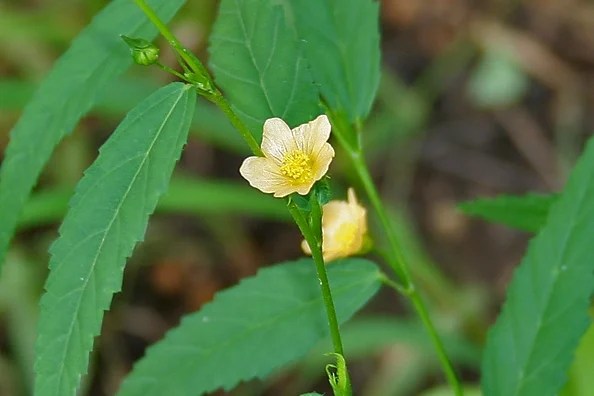
Sida: A Powerful Medicinal Herb with Global Importance
Sida, a hardy plant from the Malvaceae family, is widely valued for its medicinal properties. The herb is more colloquially known by its non-Latin names, wireweed, teaweed, ironweed, and broomweed. Amongst the herb’s common names, “broomweed,” often misspelled “broom weed,” seems to be the most popular, according to Google.
Although species like Sida Acuta are recognized globally for their antibacterial and healing benefits, among the genus of herbs of the Sida family, Sida Acuta is not the only medicinally studied plant. Sida rhombifolia and Sida Cordifolia, also show promising medicinal potential, although S. Acuta is the most thoroughly researched “broom weed” to date.
Part used
The aerial parts (parts above ground) are most often used, but the roots also contain active compounds. In short, the entire Sida plant can be used. Roots, stems, leaves, and seeds.
Traditional Uses of Sida Around the World
Sida has been used traditionally almost everywhere it grows. It’s a well-documented part of Ayurveda and African herbal medicine, although the plant genus is also native to the United States; the history of its traditional use is more limited.
- In Africa: Sida species have been used across continents for a variety of medicinal purposes. In Africa, Sida Acuta addresses malaria, fevers, and gastrointestinal problems (Karou, et al., 2005). In Africa, Sida Acuta is often referred to as wireweed or broomweed (often written as “broom weed”).
- In South America, Sida Rhombifolia and Sida Acuta ,both commonly referred to as broomweed. Sida Acuta is commonly applied to treat snake bites, respiratory diseases, and wounds. (Otero et al., 2000).
- In India, Ayurvedic practices, sida is also used for alleviating respiratory conditions, such as asthma. Sida is also used for managing infections and reducing inflammation (Oudhia et al. 2004). In Ayurvedic practices, Sida Cordifolia is most commonly used under the name “Bala”.
- In the United States, although Sida Acuta is not as historically significant, herbalists’ interest in its antimicrobial properties and potential therapeutic benefits is increasing (Flanagan et al., 1999). In the U.S., the most popular is S. Acuta, most commonly known as wireweed/broomweed.
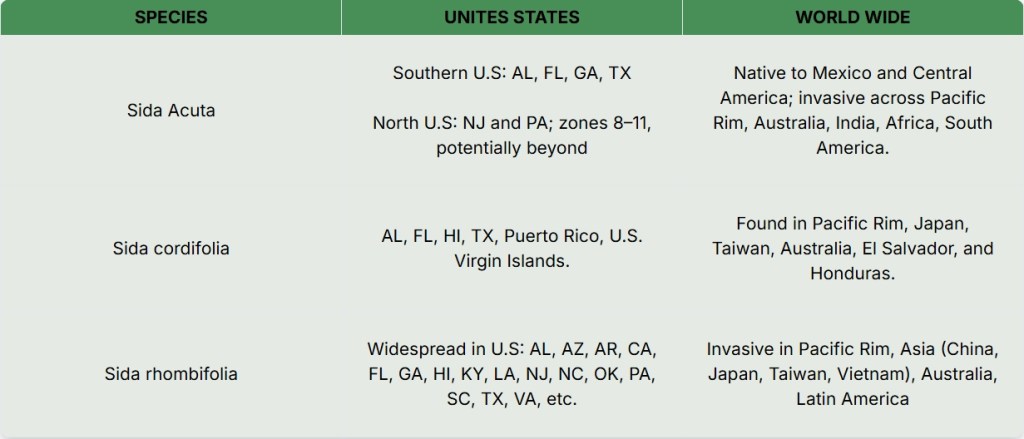
The most popular species of Sida, and where they originate
Scientific Research on Sida Species
To avoid confusion, this section will not be using any of the better-known names, such that it is clear, which Sida species is referenced. Specific areas might have a preferred nickname dependent on region. E.g in South Americans tend to refer to Sida as, broomweed, other areas might prefer wireweed, and so on.
Numerous studies have been performed, and modern medicine has verified many of the suspected benefits assumed by naturopathic healers. Studies confirm strong antimicrobial activity, especially against Gram-negative bacteria like E. coli and Pseudomonas (Chumpol et al., 2005). Furthermore, Sida´s hemo-protective properties (blood-protective), have been verified in studies utilizing an extract of Sida Acuta to neutralize snake venom (Otero et al., 2000). In a recent review of the paper from 2024 (Simplice Damintoti et al., 2024), the numerous findings of Sida Acuta’s potential as a neutralizer of toxins, as well as its properties as an antimicrobial:
“S. acuta is a plant of wide usage in traditional medicine. Following these traditional usages many studies have been conducted in laboratories for the efficiency of the plant. It is now evident that the plant has a good antiplasmodial activity due to its alkaloids principally cryptolepine the main alkaloid of the plant. It is also demonstrated that the plant is active on several bacterial strains.
Sida´s rising popularity; Lyme, Bartonella and Babesia
Studies have found antioxidant properties across the Sida genus (Kiessoun et al., 2010). Antioxidants are a great asset in detoxifying from conditions involving endotoxins, e.g., Lyme disease and gram-negative bacterial infections. Additionally, Sida has been researched for its ability to modulate the immune system. Low doses of Sida Acuta have been found to increase the total mean of white blood cells by 10% (Uduchi et al., 2022).
Sida Acuta has been found to have wide-spectrum anti-parasitic effects. In a study performed on albino rats infected with intestinal parasites, in some cases, the plant extract reduced parasite loads by up to 80%. These in vivo findings suggest that Sida’s phytochemicals, such as alkaloids and flavonoids, contribute to its ability to combat parasitosis outside of laboratory settings (Elo-Ilo et al., 2019). A screening of fresh isolates of Plasmodium falciparum (the parasite inducing malaria) found that Sida Acuta was the most potent plant tested, with “significant action” (Damintoti Karou et al., 2003). Thus, Sida’s wide anti-parasitic properties make it a staple herb in many anti-parasitic protocols, including Stephen Buhner’s anti-babesial core protocol.
Many pathogens utilize inflammation to achieve their goals within the host’s tissue. E.g., Borrelia, the pathogen causing Lyme disease, utilizes inflammatory signaling proteins called cytokines to manipulate the host’s immune response. Sida Acuta’s anti-inflammatory effects, specifically when analyzing phytochemicals, highlight ecdysterones and flavonoids as key anti-inflammatory agents (Alesiani et al., 2007). Another important phytochemical, which is not unique to Sida Acuta, but is prevalent in its plant chemistry, is cryptolepine. Cryptolepine is one of the main alkaloids that has been shown to have antiplasmodial activity, suggesting it may aid in co-infections or broader antimicrobial strategies (Banzouzi et al., 2004).
Herb/Drug Interactions and Precautions
The list might not be complete. Herbal remedies rarely have comparable pools of research to pharmaceuticals, thus this list is not comprehensive, but the following should be taken into account.
- Sida Cordifolia hypoglycemic effects could potentially interfere with diabetes medications (Kant et al., 1999).
- Compounds resembling ephedrine require cautious use alongside stimulants (Karmvir et al., 2022).
- Pregnant or breastfeeding individuals should avoid Sida, as it may affect fertility and uterine health (Ibeagi., 2023).
My experience
I started using Sida Acuta while I was already actively treating with antibiotics. When I started using S. Acuta, I would herx with every dose for about a week or so. I also noticed an increase in energy and a better overall mood, which was not something, I was seeking out, but an observed additional benefit. My starting dose was 2 ml. 3 times a day, of a 1:2 tincture.
I’m no longer treating with antibiotics, and I’m finding myself in a place overwhelmed with the symptoms that have returned over the past 10,5 weeks since quitting antibiotics.
According to Stephen Buhner, Sida Acuta can aggravate symptoms of co-infections of lyme disease. Stephen’s theory is that Sida Acuta is very efficient at breaking up bio-film. Unfortunately, herbs are not as potent as pharmaceutical antibiotics, they work, but at a much slower phase. Perhaps some of the agonies I am experiencing are a disproportionate amount of bacteria released in comparison to the bacteria killed.
In my experience, Sida Acuta’s greatest utility is its ability to reduce the “pins and needles”, often associated with bartonellosis. That symptom is maddening. The improvement in that regard alone, is enough for me to consider the herb a staple.

 Pathtoremission
Leave a comment